

- Home��
- About Us��
- Contact Us��
- Newsletter��
- FAQ��

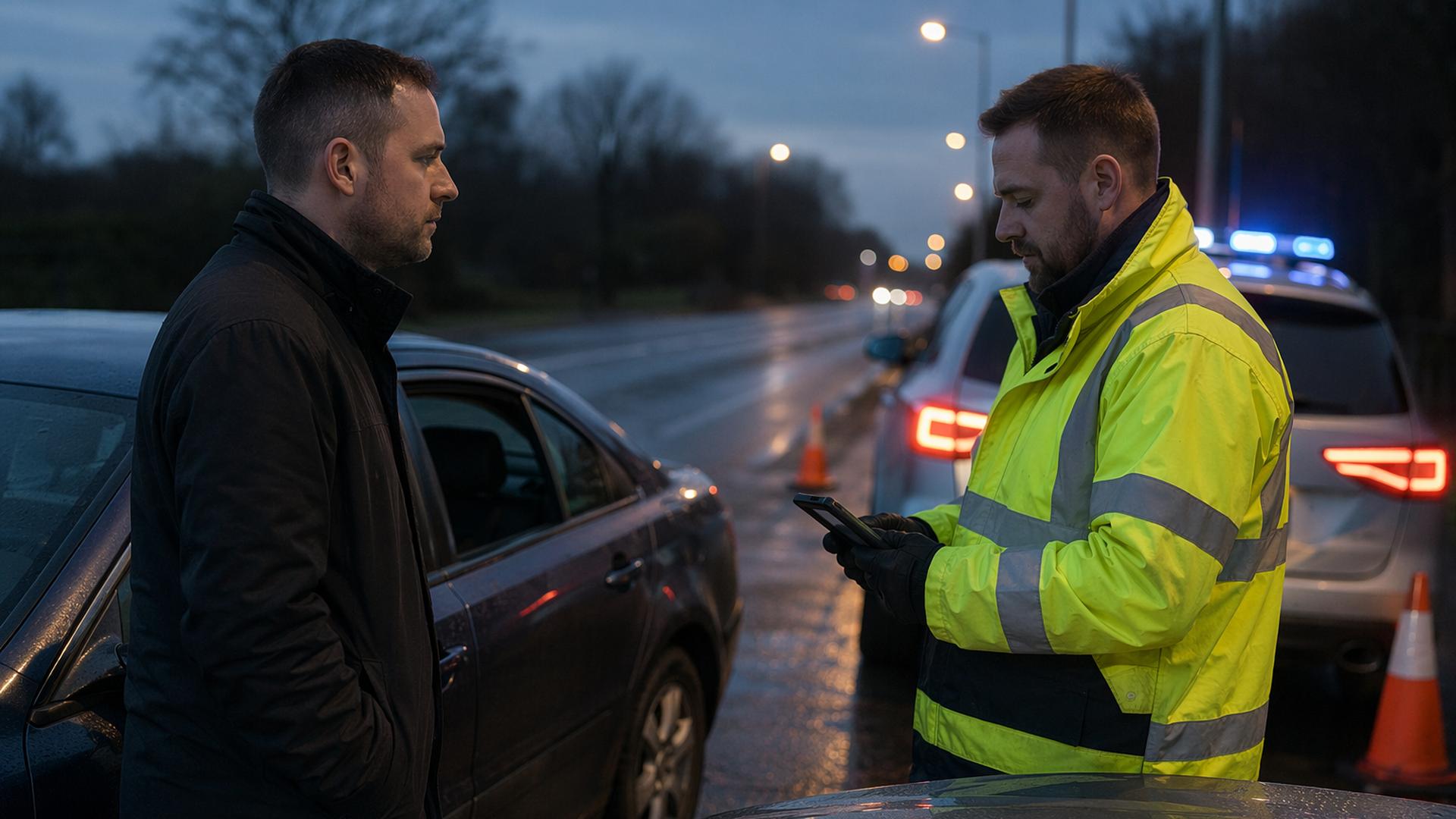
Published by Drug Driving Solicitors, specialist defence lawyers for drug driving charges across England and Wales.
Failing a roadside drug test is a disorientating experience. Within moments, an ordinary journey can give way to a sequence of formal procedures that most people have never encountered and have had no reason to think about. Understanding what those procedures are, and why each one exists, is the first step toward navigating them with clarity rather than anxiety.
This article walks through seven key stages of the drug driving process in England and Wales, from the moment an officer delivers a formal warning to the point at which a case is resolved in court. Each stage carries its own legal significance, and knowing what to expect at each one can make a real difference to how you respond and, ultimately, to the outcome of your case.
Before a police officer can require you to provide a specimen using a roadside drug testing device, they must first administer what is known as a statutory warning. This is a specific form of words prescribed by law, informing you that failure to provide a specimen is itself a criminal offence. The warning is not a formality in the casual sense; it is a legal prerequisite, and its delivery is one of the first things a specialist solicitor will scrutinise when reviewing the evidence in a drug driving case.
The precise wording of the warning is required to meet the standard set out in the Road Traffic Act 1988. If the officer departs from that wording in a material way, the evidential value of the subsequent specimen and everything that follows may be called into question. This is not a technicality in the dismissive sense of that word. It is a substantive point of law that has led to charges being dropped or convictions being overturned in cases across England and Wales.
Once the warning has been given, you are in a formal police encounter with potential criminal consequences. You are entitled to say nothing beyond providing the required specimen. Anything you say at the roadside can and will be noted by the officer and may appear in the evidence used against you. Polite cooperation with the procedural requirements does not require you to answer questions about what you may or may not have taken.
If the statutory warning is not administered, or if it is administered in a way that fails to meet the legal standard, a defence solicitor can raise this as a ground for challenging the prosecution's case. Courts have held on multiple occasions that the failure to give a proper warning undermines the legal basis on which a specimen was required. This is why documenting your recollection of exactly what was said to you, as soon as possible after the event, can be genuinely important.
Drug driving offences under Section 5A of the Road Traffic Act 1988 are summary offences, which means they are heard in the Magistrates' Court rather than the Crown Court. The case will typically come before a bench of lay magistrates or a district judge, who will consider the evidence and, if a guilty plea has not been entered, hear the arguments from both the prosecution and the defence. The proceedings are more streamlined than a Crown Court trial but no less consequential for the person in the dock.
To secure a conviction, the prosecution must establish, to the criminal standard of beyond reasonable doubt, that you were driving or attempting to drive a motor vehicle on a road or other public place, and that a specified controlled drug was present in your blood above the legal limit set out in the Drug Driving (Specified Limits) (England and Wales) Regulations 2014. The prosecution will rely primarily on the laboratory analysis of your blood sample to prove the second element, supported by the officer's account of the stop, the administration of the roadside test, and the custody records.
If the court finds the offence proven, it has the power to impose a fine of up to an unlimited amount, a community order, or a custodial sentence of up to six months. In addition to any penalty of that kind, the court must impose a mandatory driving disqualification of at least twelve months. Where aggravating factors are present, such as a previous drug or drink driving conviction within ten years, or the involvement of a collision or a child passenger, the disqualification will typically be longer.
A specialist solicitor can make a significant difference at the Magistrates' Court stage, whether the case proceeds to a contested trial or concludes with a guilty plea. At trial, the solicitor will challenge the prosecution's evidence, cross-examine witnesses, and advance any available defence. Where a guilty plea is appropriate, effective mitigation can influence the length of the disqualification and whether a custodial sentence is imposed. Neither outcome should be approached without specialist representation.
The devices currently used by police forces in England and Wales for roadside drug screening are known as type-approved drug screening devices. The most widely deployed is the Draeger DrugTest 5000. The device works by analysing a swab taken from the inside of the driver's mouth and detecting the presence of certain controlled drugs above a threshold set for screening purposes. A positive result does not constitute proof of a criminal offence; it is a trigger for the next stage of the investigation.
The current generation of type-approved devices can screen for a defined range of substances, including cannabis (specifically delta-9-tetrahydrocannabinol, or THC), cocaine, heroin-related compounds, and certain benzodiazepines, depending on the device configuration used. Critically, the device is approved only for the specific drugs it is configured to test. If a device is used to screen for a drug for which it does not have type approval, the result may be inadmissible as evidence.
A positive roadside reading does not, by itself, establish that you have committed a drug driving offence. The threshold at which the screening device produces a positive result is deliberately set lower than the legal limit, meaning the device will flag some readings that would not ultimately exceed the limit on laboratory analysis. Furthermore, the device tests for the presence of a substance, not for impairment. The prosecution must rely on the blood sample, not the roadside swab, to establish the offence.
The roadside is not the place to explain your medication, justify your behaviour, or offer an account of what you have or have not consumed. Officers are experienced at conducting these encounters, and statements made at the roadside will be recorded. Your obligation at this stage is to provide the requested specimen when properly required to do so. Beyond that, exercising your right to remain silent is always a sensible approach until you have had the opportunity to speak with a solicitor.
Following a positive roadside reading, the officer will place you under arrest on suspicion of a drug driving offence under Section 5A of the Road Traffic Act 1988. You will be cautioned using the standard police caution, informed that you are under arrest, and told the reason for the arrest. Your vehicle may be left at the scene or recovered by a third party if you are unable to make alternative arrangements. The officer will then transport you to a custody suite, typically the nearest police station with a designated custody facility.
On arrival at the custody suite, you have a number of important legal rights. These include the right to have someone informed of your arrest, the right to consult the Codes of Practice governing police detention, and, most importantly, the right to free independent legal advice. You should request this immediately and unequivocally. The duty solicitor service is available around the clock and at no cost to you. Do not be deterred by any suggestion that requesting a solicitor will delay your release or worsen your situation.
The custody sergeant is an officer independent of the arresting officer whose role is to oversee your detention and ensure that your rights are observed. They will read you your rights, confirm the grounds for your detention, and authorise your continued detention if the grounds are satisfied. The custody sergeant will also arrange for a healthcare professional to attend to take a blood sample. All of this is recorded in a custody record, which forms part of the evidence in your case and which your solicitor is entitled to review.
Time in custody for a drug driving investigation is typically several hours. You will be searched, your property will be itemised and stored, and you will be placed in a cell while the relevant procedures are arranged. The pace of the process depends on the availability of a healthcare professional, the custody suite's workload, and any legal advice you choose to take. Remaining calm and cooperative with the procedural requirements, while saying nothing substantive about the alleged offence, is the recommended approach throughout.
Once the blood sample has been taken and divided, the police retain one part and you are offered the other. The police portion is packaged, labelled, and transferred to a nominated forensic science laboratory under a documented chain-of-custody process. Every person who handles the sample, and every stage of its journey from the custody suite to the laboratory, must be recorded. Any break in that chain is a potential defence point, because it raises the question of whether the sample that was analysed was the same sample that was taken from your blood.
The forensic laboratory will analyse the sample to determine whether a specified controlled drug is present and, if so, whether its concentration exceeds the legal limit set out in the 2014 Regulations. The laboratory will produce a formal report setting out the methodology used, the concentration found, and the margin of analytical uncertainty. It is this report, not the roadside device reading, that forms the scientific cornerstone of the prosecution's case.
The specified limits vary significantly between substances. For THC (cannabis), the limit is 2 micrograms per litre of blood; for cocaine, it is 10 micrograms per litre. Some substances, including certain prescription medications such as clonazepam and diazepam, have limits set at levels that account for therapeutic use. Exceeding the specified limit is sufficient for the offence to be made out, regardless of whether there was any actual impairment. The strict liability nature of the offence is one of the reasons specialist legal advice is so important.
Laboratory analysis is the primary source of delay in the drug driving process. Forensic laboratories have significant workloads, and the turnaround time from receipt of a sample to the production of a full toxicological report can range from several weeks to several months, depending on the laboratory and the complexity of the case. This is why the period between an arrest and a charging decision can often span several months, and why many people hear nothing from the police for a considerable time after the incident.
The blood sample at the custody suite must be taken by a healthcare professional. In practice, this is most commonly a forensic medical examiner (also known as a police surgeon or custody nurse), a registered nurse, or a registered paramedic. The requirement that a healthcare professional rather than a police officer takes the sample is a legal protection, designed to ensure that the procedure is conducted safely and to the appropriate clinical standard. If the sample is taken by someone who does not meet the legal definition of a healthcare professional, the validity of the sample may be challengeable.
The healthcare professional will take a venous blood sample, usually from a vein in the forearm. Before doing so, they are required to ask whether you have any medical reason that would prevent the sample from being taken safely. You should disclose any relevant condition at this point; however, a medical reason for declining must be genuine and supportable by evidence. The professional will use a standard blood collection kit and will follow a documented procedure to ensure the integrity of the sample.
One of the most important procedural rights at this stage is your entitlement to be offered part of the blood sample. The sample is divided into two portions: one retained by the police for analysis, and one offered to you. You should accept your portion and ensure it is stored appropriately, because it is the foundation for any independent expert analysis you may wish to commission as part of your defence. A solicitor can advise you on how to arrange independent testing and what a second opinion might reveal.
If a genuine medical condition makes it impossible for a blood sample to be taken, a urine specimen may be requested as an alternative in limited circumstances. However, the legal framework governing when a urine specimen may be substituted is narrow and specific. Do not assume that a fear of needles or a mild medical condition will automatically constitute a valid excuse. If you have a genuine clinical reason, raise it with the healthcare professional and ensure it is documented in the custody record.
Being charged with a drug driving offence means that the police, having reviewed the laboratory report and the wider evidence, have determined that there is sufficient evidence to bring a prosecution and that doing so is in the public interest. You will be given a charge sheet setting out the specific offence, the date and location of the alleged incident, and the name of the court where your case will be heard. Depending on the circumstances, you may be bailed to appear at court on a specified date, or released under investigation pending a charging decision at a later stage.
A decision that no further action will be taken means that the case is closed and no prosecution will follow. This outcome can arise for a range of reasons: the laboratory analysis may show that the drug concentration was below the legal limit; the blood sample may have been compromised; procedural errors may have been identified that undermine the prosecution's ability to prove the case; or the prosecution may have concluded that it is not in the public interest to proceed. A no further action outcome is not an acquittal in the formal sense, but its practical effect for the individual is the same.
When a charge is brought, the custody sergeant or a court may impose bail conditions. In drug driving cases, conditions requiring you to reside at a specified address or to surrender to a police station at intervals are relatively uncommon, but conditions restricting your ability to drive are sometimes imposed where the court considers it appropriate. Your solicitor should challenge any condition that goes beyond what is proportionate to the nature of the alleged offence, particularly if a driving ban would cause serious hardship.
The charge sheet will specify the offence under Section 5A of the Road Traffic Act 1988, identify the drug or drugs found above the legal limit, and set out the date, time, and location of the alleged offence. Reading the charge sheet carefully, and comparing its contents against your own recollection of events, is an important early step. Any discrepancy, however small it might seem, should be flagged to your solicitor. Errors in the charging document can sometimes be significant, and a specialist solicitor will know whether they are worth pursuing.
Understanding the seven stages described in this article will not resolve a drug driving case on its own, but it will give you a meaningful advantage over those who approach the process in the dark. Each stage carries legal significance, each creates opportunities for a skilled defence solicitor to test the prosecution's evidence, and each requires a response that is informed rather than reactive. If you have been through any of these stages, or if you are at the beginning of the process, the most important thing you can do is seek specialist advice early.
DG10 is the DVLA offence code recorded against your driving licence when you are convicted of driving or attempting to drive with a controlled drug above the specified limit under Section 5A of the Road Traffic Act 1988. The code remains visible on your licence for eleven years from the date of conviction and can be seen by any insurer who accesses the DVLA database during a standard check. The financial consequences are significant: insurance premiums typically rise substantially following a DG10 endorsement, in some cases making cover difficult to obtain at any reasonable cost. A specialist solicitor can advise you on the full range of implications a DG10 conviction may carry for your particular circumstances, including the effect on professional licences, overseas travel, and employment.
A drug driving conviction can have serious consequences for employment, depending on your role and industry. Professions that require a clean driving licence, such as delivery drivers, HGV operators, and taxi drivers, will be directly affected by the mandatory disqualification. Beyond that, many employers conduct criminal record checks, and a conviction may need to be disclosed, particularly for roles involving trust, security clearance, or work with vulnerable people. Some regulated professions, including law, medicine, and financial services, require individuals to self-report convictions to their regulatory body. If your employment is at risk, this should be discussed with a specialist solicitor at the earliest opportunity, as it may inform both the conduct of your defence and the approach to mitigation at sentencing.
There are several grounds on which drug driving charges are regularly challenged and discontinued. The most frequently encountered include: failure to administer the statutory warning in the correct terms before requiring the roadside specimen; use of a screening device without the relevant type approval for the specific drug in question; deficiencies in the chain of custody of the blood sample; failure to offer the defendant their portion of the divided blood sample; errors in the laboratory analysis or its documentation; and an unlawful initial stop or search. A specialist solicitor will review all of these areas as a matter of course, not merely the headline figure in the blood test report.
The period between a positive roadside test and a charging decision typically falls somewhere between two and six months, although it can extend beyond that in more complex cases or where laboratory demand is particularly high. The principal source of delay is the forensic analysis of the blood sample, which is dependent on the laboratory commissioned by the relevant police force and its current workload. Once the laboratory report is received, the charging decision is generally made within a relatively short timeframe. If you have not received any communication from the police within six months of the incident, it is advisable to seek specialist legal advice to understand your current position.
Refusing to provide a blood specimen without a reasonable excuse is a criminal offence in its own right under Section 7A of the Road Traffic Act 1988, and it carries the same penalties as a conviction for drug driving itself, including the mandatory twelve-month disqualification. The category of "reasonable excuse" is interpreted very narrowly by the courts, and a claimed medical reason will need to be supported by credible evidence. A fear of needles, for example, has not generally been accepted as a reasonable excuse. If you are genuinely unable to provide a sample for medical reasons, ensure that this is raised with the healthcare professional and documented properly. Under no circumstances should you refuse without first speaking to a solicitor.
A statutory medical defence is available under Section 5A(3) of the Road Traffic Act 1988 to drivers who can demonstrate that the drug detected was lawfully prescribed or supplied to them, that they took it in strict accordance with medical advice, and that their driving was not impaired at the time. The defence exists to protect those using medication legitimately, but it is more narrowly construed than many people assume. It must be properly evidenced, which means obtaining documentation from the prescribing clinician and, in many cases, commissioning expert pharmacological evidence. Drug Driving Solicitors has specific expertise in prescription medication cases and can advise on whether the defence is available and how it should be advanced.
Drug Driving Solicitors is a specialist law firm representing clients in drug driving cases throughout England and Wales. If you have received a positive roadside drug test result and want to understand where you stand, contact us today for a free initial consultation or visit drugdrivingsolicitors.co.uk. Getting advice early is cost-free and can have a profound impact on how your case unfolds.